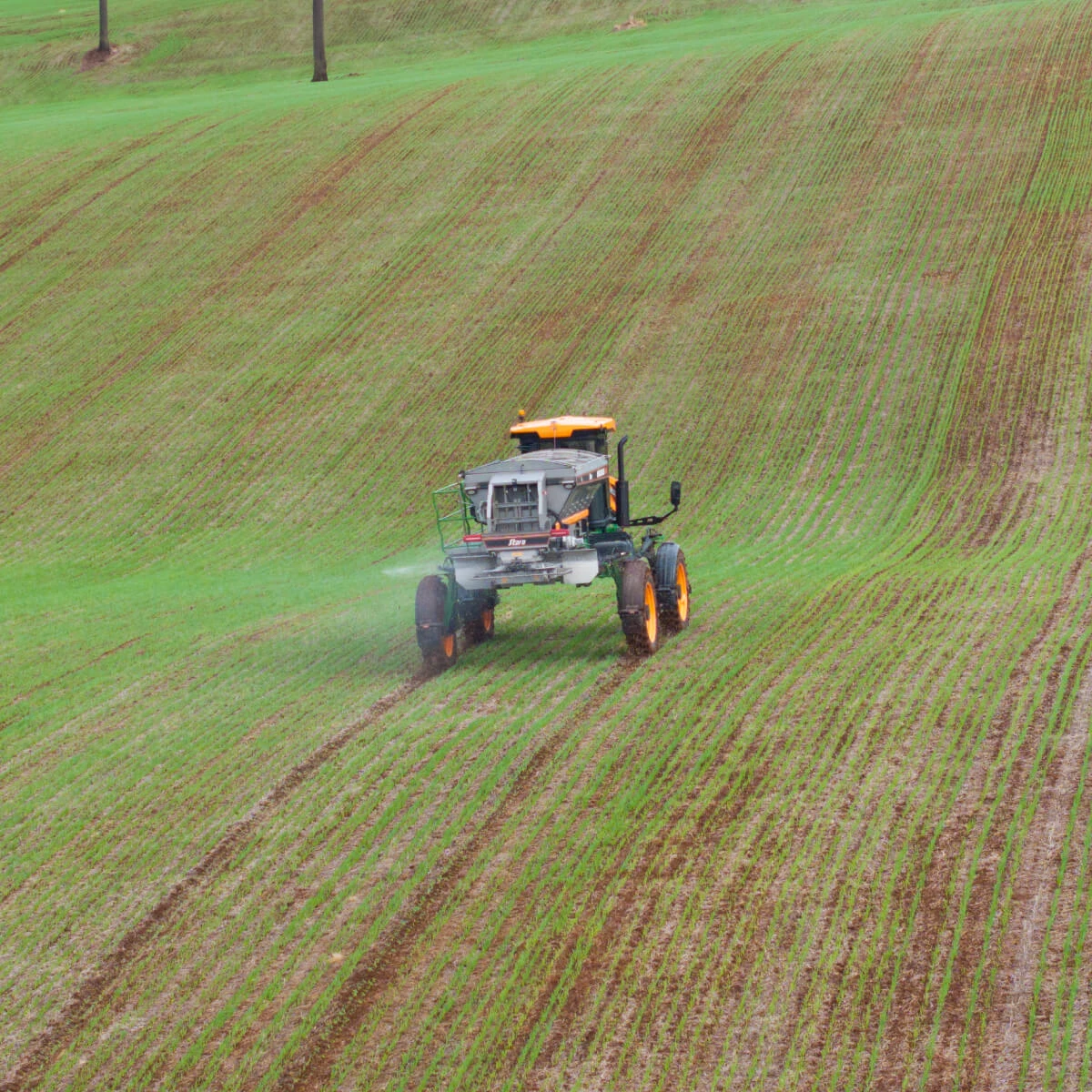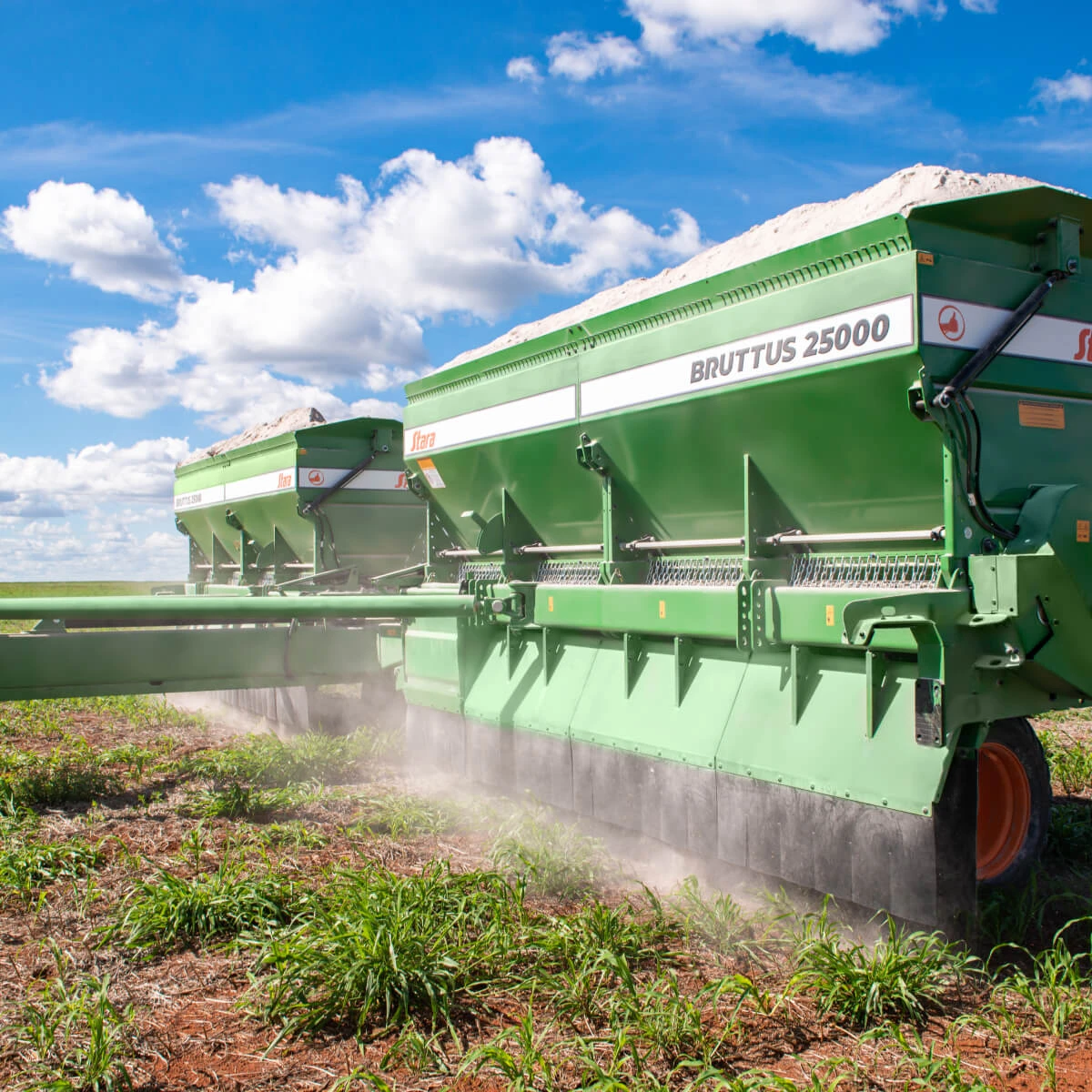



The efficient use of fertilisers and soil conditioners is essential to ensure productivity and economic return in the field. The study 'Efficient use of fertilisers and soil conditioners: agronomic aspects' highlights the importance of even input distribution in the soil to maximise nutrient uptake and reduce losses caused by overlap or missed areas.
Since the result depends directly on how the fertiliser is applied, the distribution system plays a key role in application quality. In this context, boom fertiliser distribution stands out as a technical solution designed to deliver greater uniformity and more precise rate control.
This guide explains how the system works, the agronomic and operational benefits it offers, and how Stara's new spreader concept, introduced with the Spartakus, takes control and precision in field fertiliser application to a new level.
What is boom fertiliser distribution?
Boom fertiliser distribution is a method of applying fertiliser in a controlled linear pattern across a defined strip of soil. Unlike centrifugal spreading, where the product is thrown outwards by discs, a boom system delivers the fertiliser in a continuous flow to outlets positioned along the boom, ensuring greater distribution stability across the working width.
This approach applies Precision Agriculture principles to reduce lateral variation, improve uniformity across the full working width and minimise overlap between passes.
As a result, boom application of granular fertilisers is increasingly used in operations that demand technical precision and integration with Precision Agriculture.
How does a boom distribution system work?
The system combines mechanical and electronic components that work in sync to control flow and ensure consistent application. Its main elements are:
- hopper: stores the fertiliser and must maintain a constant flow, preventing compaction or tunnelling;
- metering system: regulates the amount of fertiliser released, allowing the application rate to be adjusted precisely in line with agronomic recommendations;
- pressurised air system: carries the fertiliser from the metering units to the outlets along the boom through ducts, ensuring continuous flow and uniform distribution across the working width;
- outlet system along the boom: distributes the product in a linear pattern, controlling deposition across the boom width;
- electronic flow control: allows the application rate to be adjusted, integrates with prescription maps and provides real-time monitoring. The system also performs rate compensation on curves, adjusting distribution between boom sections to maintain uniformity. This feature is essential in Precision Agriculture operations.
The combination of these elements determines the level of uniformity achieved and the machine's performance in the field.
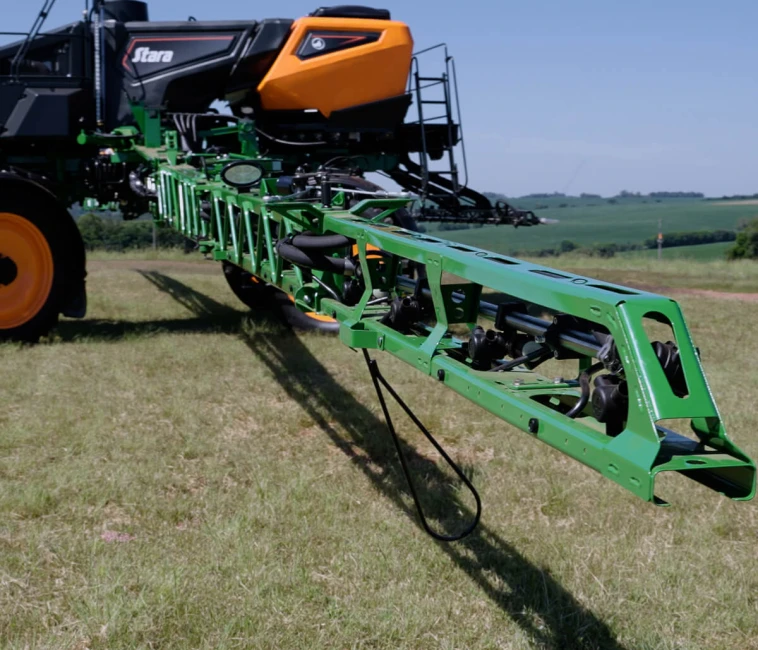
In addition to the metering and conveying components, the structural stability of the boom directly affects application uniformity across the working width. Excessive vibration, structural twisting or uneven ground can alter the deposition pattern along the boom.
For this reason, the engineering of the agricultural machine must ensure rigidity, balance and uniform flow distribution across the entire working width.
In the Stara Spartakus, this control is further enhanced using centre booms, a distinctive brand feature that contributes to greater structural stability and more uniform flow distribution during operation.
Difference between boom distribution and broadcast seeding
Broadcast seeding uses rotating discs to spread the fertiliser laterally, creating a wide spreading pattern whose performance depends on overlap between successive passes of the machine.
This system is sensitive to variations in forward speed, disc speed, wind and granule size, which can affect distribution uniformity. In practice, it may produce a triangular spread profile, with a greater concentration in the centre of the spread width and lower deposition at the edges, or vice versa.
Boom distribution, by contrast, places the fertiliser in a controlled linear pattern across the full working width, reducing overlap and improving application consistency.
A boom system is recommended when there is a need for:
- greater accuracy in the application rate per hectare;
- the use of prescription maps;
- variable-rate application.
It is also well suited to operations near field boundaries and in irregularly shaped fields, where precise control of the working width is essential to reduce waste and maintain uniformity.
A new agricultural machine concept for boom distribution
The drive for greater precision in fertiliser application, lower waste and closer integration with Precision Agriculture has been reshaping the development of agricultural machinery.
Boom distribution is no longer merely a technical alternative. It has become a strategic approach to improving operational and agronomic control during application. As a result, machine design must evolve in line with field demands.
Spartakus: the new concept introduced by Stara
As part of this evolution, Stara introduced Spartakus as a new agricultural machine concept. The machine combines pneumatic fertiliser distribution, spraying and boom seeding in a single structure.
According to Stara product engineer Cícero Roessler, this integration is precisely what sets it apart.
It is a new concept because, unlike other machines on the market, it combines spraying and the pneumatic distribution of fertilisers and seeds through the boom in a single machine, instead of being limited to fertiliser distribution alone.
This means the innovation lies not only in the distribution boom itself, but also in the integration of this technology with spraying and seeding functions in a single machine.
The new concept is based on integrating boom distribution technology into the sprayer platform within a single machine.
This architecture broadens operational possibilities and supports new management strategies across the farming business.
Technical features of Spartakus
Spartakus was designed to deliver greater stability and control in input application. Its pneumatic distribution system carries fertilisers and seeds along the boom to specific outlet points, ensuring more uniform deposition across the working width.
The machine' structure also enables section control and curve compensation, both of which are important for reducing overlap and missed areas during operation. In addition, the system removes the need for vane adjustments, which are common in centrifugal spreaders.
Another notable feature is its greater tolerance of adverse environmental conditions. Because the product is conveyed directly through the boom, the operation is less affected by wind than in broadcast seeding systems.
According to Roessler, this widens the application window.
Our aim was to make application possible under windier conditions and with greater precision, through section control and curve compensation. Another important objective was to eliminate the need for vane adjustment.
These features allow the machine to maintain a more stable application pattern, even in conditions that would normally restrict the operation.
Impact of the machine on fertiliser management in the field
The introduction of machines with greater structural control and integrated technology has a direct effect on fertiliser management on the farm. Operators gain greater predictability in application rate, distribution uniformity and overall operational performance.
Reducing operational variability helps to standardise the application process and reduces the need for corrective adjustments in the field. Greater technical stability also allows agronomic recommendations to be followed more accurately.
In practice, this means closer alignment between the prescribed and applied rates, more efficient use of fertilisers and greater control over the cost per hectare across the field.
7 benefits of boom fertiliser distribution
Crop nutrient uptake depends directly on how fertiliser is distributed across the soil. Boom distribution helps ensure more stable application and more efficient use of inputs across the field. The main benefits are outlined below.
1. Application uniformity
Linear deposition allows more precise control of the application width, reducing the lateral variation commonly associated with broadcast seeding systems. More consistent distribution reduces the occurrence of areas receiving either too much or too little fertiliser.
In addition, electronic control systems enable rate compensation on curves, adjusting distribution between boom sections to maintain uniform application even when the machine changes direction.
This uniformity promotes more balanced nutrient uptake by the crop, reducing uneven competition between rows and across the field. The result is more even crop development.
2. Better use of fertiliser
By reducing misses and overlap, a boom system improves the efficiency of input use. The applied rate stays closer to the agronomic recommendation, reducing losses caused by uneven distribution.
Lower localised product concentration reduces surface losses and helps ensure a better crop response to the volume applied. This results in better control over cost per hectare and more efficient fertiliser management on the farm.
3. Greater predictability of crop response
Application uniformity is associated with more predictable crop performance. When nutrient availability is distributed more evenly, plant development also tends to be more uniform.
In crops such as soybeans, maize and other grains, this nutritional stability contributes to better stand establishment, more even growth and more consistent results across the field.
This level of agronomic control has supported the development of new agricultural machine concepts designed for boom distribution. The structural and technological evolution of the system has led to solutions such as Spartakus, which combines mechanical robustness with electronic control to deliver more stable application in the field.
4. Precise distribution, even in windy conditions
Because the fertiliser is conveyed through the distribution system to the outlets along the boom, the application is less affected by wind than in broadcast seeding systems.
This extends the operating window in the field and allows greater application stability to be maintained even in wind conditions that would normally compromise distribution uniformity.
5. Easy to calibrate
The boom distribution system also simplifies machine calibration. In the case of Spartakus, the operator only needs to set the application rate, without having to calibrate the working width using trays.
This makes adjustment more practical and reduces the time needed to prepare the machine for operation.
6. Fertiliser application at more advanced crop stages
The machine's Up & Down – hydraulic lift system makes it possible to operate in taller crops. Its height adjustment system allows the machine to be raised, enabling it to enter the field even when the crop is at a more advanced stage of development.
In crops such as maize, this expands the possibilities for nutritional management throughout the growing cycle.
7. Pressurised hopper
The pressurised hopper helps maintain a constant fertiliser flow within the distribution system. This feature helps prevent variation in product feed and improves application stability along the boom.
As a result, the applied rate remains closer to the agronomic recommendation, reinforcing precision in fertiliser application on the farm.
Precision in boom distribution: calculation, set-up and application control
Ensuring the correct fertiliser rate per hectare is a fundamental step in maintaining fertiliser efficiency and controlling cost per hectare. In boom distribution, application can be planned according to the machine's operating parameters, such as fertiliser flow rate, effective boom width and working speed.
In technical terms, the application rate can be estimated using the following formula:
- Rate (kg/ha) = (Flow rate (kg/min) × 10,000) ÷ (Speed (m/min) × Effective width (m))
This calculation makes it possible to determine the quantity of fertiliser needed to meet the agronomic recommendation for the field, taking into account the crop, soil analysis and yield target. However, performance in the field depends not only on setting the correct rate, but also on how the machine delivers that application in practice.
In the case of Spartakus, the application set-up process was designed to be simpler and more precise. Unlike traditional broadcast seeding systems, which require the application width to be calibrated using trays, the machine only requires the application rate to be set.
Because the fertiliser is conveyed through the boom and released in a controlled manner across the working width, application uniformity does not depend on spread-width calibration, regardless of the type of product used.
Another distinguishing feature is the level of operational control during application. The operator can adjust the fertiliser rate directly through the machine's system and switch individual boom sections on or off.
This level of control improves distribution accuracy, reduces overlap and makes better use of the applied fertiliser. In the field, this means easier operation, more accurate implementation of the agronomic recommendation and greater input savings on the farm.
Preventive maintenance is essential to system performance. Cleaning the hopper helps prevent product build-up, inspecting the metering units and mechanisms supports consistent distribution, and checking the sensors helps ensure that the monitored rate matches the actual field application.
How do Stara's Precision Agriculture solutions increase control in boom distribution?
The integration of boom fertiliser distribution with Precision Agriculture becomes a reality when the machine operates in connection with controllers, synchronisation systems and data management platforms.
In Stara's solutions, this connection supports fertiliser application throughout the operation. According to Cícero:
The machine integrates with Syncro, Conecta and Telemetry. It can also operate with apps such as Stara Spraying and Stara Distribution.
Stara's product engineer explains that the data generated during the operation then become part of the farm's agronomic management process.
With telemetry, fleets and operations can be managed through application maps that show the quality of distribution.
Topper: real-time variable-rate control
Variable-rate application is managed through Topper, the agricultural controller responsible for interpreting prescription maps and automatically adjusting the rate according to the machine's position in the field.
The system controls fertiliser flow in real time, helping to ensure that the applied rate follows the agronomic recommendation more closely and consistently across the working width.
Data as a management tool
During operation, application data are recorded and can be monitored via Stara Telemetry, which makes it possible to track the applied rate, covered area and operational performance, while also maintaining a detailed record of applications carried out on the farm.
In addition, the machine is integrated with Land Space, Stara's technology ecosystem, which expands the use of the brand's digital solutions through satellite connectivity.
In this way, Stara turns boom distribution into a data-driven process. Application no longer depends solely on manual adjustment, but it is carried out based on agronomic prescription, continuous monitoring and technical fertiliser management.
Precision that turns fertilisation into a strategy
In this article, you have seen how boom fertiliser distribution stands out as a technical approach to improving fertiliser efficiency on the farm.
When calculation, set-up and technology work in alignment, application is no longer merely an operational task - it becomes part of the farm's production strategy.
In this context, the new agricultural machine concept introduced by Stara marks a further step in this evolution. Spartakus expands the potential of boom distribution by combining robustness, precision and built-in intelligence, raising the level of application control and strengthening efficient fertiliser management.
Frequently asked questions about boom fertiliser distribution
What types of fertiliser is boom distribution suitable for?
The system is used mainly for granular fertilisers. Compatibility depends on the product's flowability, granule size and moisture content.
Can boom distribution be used in any crop?
Yes, provided the agronomic recommendation and management strategy are aligned with the crop and its stage of development. The system is commonly used in grain crops, but it can also be applied in other production contexts.
Does a boom system completely replace broadcast application?
A boom distribution system can replace a broadcast system when the product being applied is granular. However, it is not suitable as a replacement when the product is in powder form.
Can boom distribution be integrated with digital management systems?
Yes. Machines equipped with electronic controllers and connectivity can record operational data, integrate prescription maps and store application history for later analysis.
Does boom distribution require specific operator training?
Operation requires technical knowledge of set-up, application rate and electronic monitoring. Proper training helps maintain application stability and reduce operational variability.
Did you like the hints and want to find out the agricultural machine that best suits your crop field?
Stop by a Stara dealer and find the most suitable equipment to boost your crop production. Request a quotation.
*O Spartakus não está disponível para a venda, por se tratar de um conceito de produto que ainda está em desenvolvimento.