


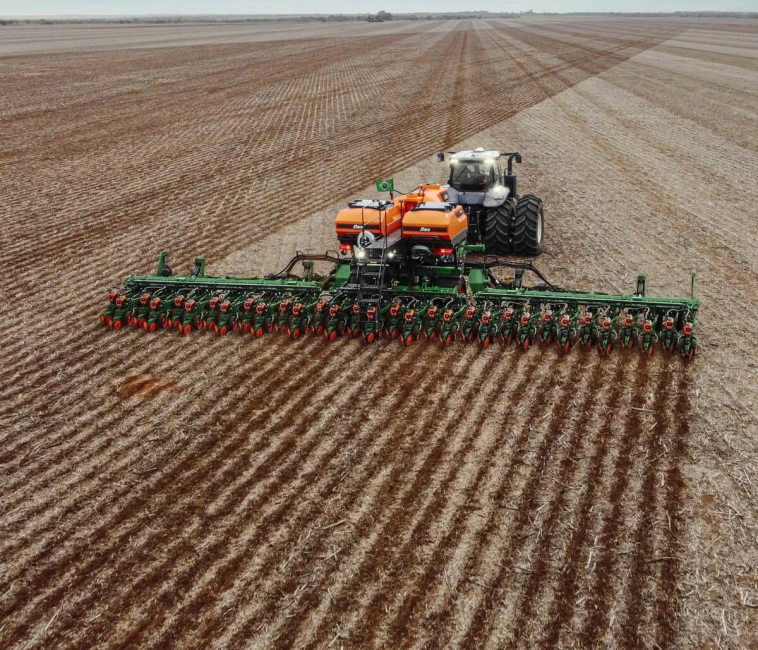
During field operations, machinery follows predefined guidance paths for each task. During planting, for example, the machine must move from one pass to the next without leaving gaps or planting again where seeds have already been placed. In spraying and spreading operations, the same principle makes it possible to cover the planned area while avoiding misses and overlaps.
For this movement to be carried out using automated guidance features, the machine must be able to identify its position in the field. This positioning information enables technologies such as automatic steering to guide the machine, while shut-off systems recognise where a specific function should be interrupted. Therefore, the more accurate the machine's location information, the better the reference available to these technologies.
This location is determined through satellite navigation systems, but the calculated position may differ from the machine's actual location. To reduce these errors, signal correction services are used, increasing positioning accuracy.
In this article, learn how signal correction works and why it is important for the accuracy of agricultural operations.
What Is Signal Correction and Why Is It Necessary?
Global Navigation Satellite Systems (GNSS) enable the machine's receiver to calculate its position based on signals transmitted by satellites. However, this calculation is subject to several sources of error, which may cause the indicated position to differ from the machine's actual location.
This is where correction services come into play. They provide additional information to the system in order to reduce these discrepancies and improve positioning accuracy. In precision agriculture, this information can be used by various technologies that depend on machine location to perform their functions.
There are different methods of signal correction, with characteristics varying according to the service used. At Stara, for example, this correction is provided through the Sinal Pago service for compatible machines and equipment.
How Does Signal Correction Work in Agriculture?
To correct the position calculated by the receiver, a reference point is required to identify and reduce positioning errors. One of the technologies used for this purpose in agriculture is Real Time Kinematic (RTK).
In this system, a reference station or network operates from known coordinates. The information received from satellites is compared against this reference, allowing correction data to be calculated and transmitted to the machine's receiver. Using this information, the system can determine the machine's position with greater accuracy.
This is one example of a correction architecture. Other services may use different technologies. Therefore, in addition to the technology employed, factors such as coverage within the operating area, receiver compatibility, accuracy and repeatability should be considered according to the needs of the operation.
On Stara self-propelled machines, such as the Imperador sprayer range and Hércules spreaders, the Sinal Livre service is available as standard. To further increase positioning accuracy and expand the use of onboard technologies, Sinal Pago can be purchased as an optional feature. On equipment fitted with Land Space, the solution is already included in the package.
For planters, Sinal Pago provides an additional benefit for technologies that depend on positioning. In addition to the signal used by the tractor, the planter itself may be equipped with a correction antenna. This means that positioning is determined directly on the machine responsible for seed placement, providing a more accurate reference for planting-row functions.
On Stara planters equipped with the Land Space ecosystem, Sinal Pago is also included among the technologies delivered with the machine. Matheus Henrique Baumgratz, Agronomist and Product Marketing Analyst at Stara, explains how this configuration simplifies operation:
“Planters equipped with Land Space leave the factory with Sinal Pago already included in packages valid for three years. As a result, Row-by-Row Shut-Off and Zero Plant Crushing are factory-calibrated, making preparation for planting much easier.”
For these features to use positioning data correctly, signals must be received under favourable conditions. Buildings, tall trees and other obstacles may interfere with satellite communication and reduce positioning quality. During calibration procedures, selecting an open area free from obstructions improves signal reception and facilitates the required adjustments.
What Are the Benefits of More Accurate Positioning?
The benefits of more accurate positioning can be seen throughout agricultural operations. In practice, their effects can be observed from planting through to later field activities, depending on the technologies installed on each machine.
During Planting
During planting, while the tractor uses its own signal for functions such as automatic steering, signal correction can be applied directly to the planter. This enables the position of the seed-placement equipment to be determined more accurately and improves the performance of the onboard technologies.
For example, in the Row-by-Row Shut-Off system, the planter's position is used to determine more precisely where each row should stop or resume seed placement, helping to reduce misses and overlaps.
The planter's position also plays an important role in traffic planning. With Zero Plant Crushing, planting rows are switched off in the lanes designated for the wheels of sprayers and spreaders during subsequent operations. This avoids placing seeds in areas where machinery traffic will occur, reducing crop damage and providing seed savings of up to 4%, depending on the crop, working width, track width and wheel-track dimensions.
During Spraying and Spreading Operations
In self-propelled machines, having more accurate information about the machine’s location allows the automatic steering system to use a more precise reference for keeping the machine on its planned path.
In spraying operations, positioning data also serves as a reference for the Nozzle-by-Nozzle System, which automatically switches off individual nozzles whenever the controller identifies an area where the spray mixture has already been applied. This control is particularly important at headlands, field boundaries and pass intersections, helping to reduce overlaps and unnecessary applications.
In spreading operations, positioning information is used by section control systems to stop product application in areas that have already been treated. It also supports variable-rate applications, as the machine's location allows different zones defined within the prescription map to be identified more accurately, ensuring that the planned rate is applied to each area of the field.
However, the benefits of positioning are not limited to the operation currently being performed. In some situations, the guidance lines created must continue to serve as a reference when machinery returns to the field at other stages of the growing season.
Why Is Repeatability Important Throughout the Season?
Pass-to-pass repeatability is the ability to return to a previously established guidance line. In controlled traffic systems, it allows the tracks defined during planting to serve as a reference for sprayers and spreaders during subsequent operations.
An example of this can be seen with Zero Plant Crushing. The traffic lanes designated for machinery only serve their purpose if the wheels of subsequent machines travel along the planned paths. Reusing these guidance lines also depends on compatibility between the wheel tracks of the different machines. When guidance lines are available and compatible, the automatic steering system can use them as a reference to guide the machine along the intended route.
What Is the Relationship Between Signal Correction and Automatic Steering?
Signal correction and automatic steering perform different functions, but they work together as part of the same system. Signal correction reduces errors in the machine’s calculated position, while automatic steering uses this information to identify deviations from the defined trajectory and adjust the machine’s steering during operation.
On Stara self-propelled machines, this guidance is provided by the Topper Driver 3 (TD3), an automatic steering system designed to follow planned straight or curved guidance lines. The system stands out for its rapid response time during operations, helping to reduce misses and overlaps along the route. It also enables controlled traffic farming and pass-to-pass repeatability.
To use this feature effectively, guidance lines and operating parameters must be configured according to the specific operation and the machine on which the system is installed. Calibration complements this process by preparing the automatic steering system to make full use of positioning information during fieldwork.
How Does Land Space Integrate Different Technologies into the Operation?
Sinal Pago is part of the Land Space ecosystem, which also brings together technologies focused on connectivity and operational monitoring. As a result, in addition to using a more accurate positioning reference during fieldwork, growers can monitor information generated by the machine throughout the operation.
With Stara Telemetry, it is possible to monitor the machine’s location in real time and view data from completed operations. Satellite connectivity keeps the machine connected and enables additional services, such as Conecta, Stara’s after-sales support service, which provides direct remote assistance from the factory.
In addition, Syncro Net allows up to five machines performing the same operation to work synchronously in the same field, sharing information via the internet.
Greater Accuracy in Your Operation with Stara Solutions
Sinal Pago enhances positioning accuracy and provides a more reliable reference for the technologies used throughout different field operations. Integrated with Stara solutions, this feature helps maximise the performance of guidance, automation and control functions during daily operations.
On machines equipped with the Land Space ecosystem, this integration goes even further by combining signal correction, connectivity and technologies that enable operational information to be monitored and shared.
Discover Stara's precision agriculture solutions and find out how Sinal Pago can bring greater accuracy and technology to your field operations.
Frequently Asked Questions About Agricultural Signal Correction
Can Signal Correction Be Used on Any Agricultural Machine?
The use of signal correction depends on the compatibility between the machine, the receiver and the technologies that use positioning information. On Stara machines, the availability of Sinal Pago varies according to the model and equipment configuration.
How Can I Check the Availability of Stara's Sinal Pago?
Sinal Pago is available for compatible Stara self-propelled machines and planters. On self-propelled machines, it can be purchased as an optional feature to improve positioning accuracy. On equipment equipped with Land Space, Sinal Pago is already included as part of the technology ecosystem available on the machine.
What Happens if Signal Correction Is Interrupted?
Without correction data, positioning accuracy may be reduced. As several technologies rely on this reference during field operations, the machine's behaviour in the event of an interruption will depend on the equipment and its configuration. If assistance is required, operators can consult the machine's operator manual or contact Conecta.
Interested in Stara Solutions for Your Farming Operation?
Find your nearest Stara dealership and explore the possibilities offered by Sinal Pago and the automatic steering system on your machine. Our team can help you choose the configuration best suited to the needs of your farming operation.
Speak to a Specialist

