


Understanding how to adjust planters and seeders is a crucial step to achieving uniformity in the planting of soybeans, maize, and wheat. In these crops, the correct adjustment of agricultural machinery affects seed distribution, fertiliser placement, sowing depth and the quality of the operation, which promotes more uniform crop emergence.
The National Supply Company (Conab) monitors the performance of the Brazilian grain harvest on a monthly basis, emphasising the importance of planning and decision-making throughout the production cycle. In this context, the correct adjustment of agricultural machinery is one of the steps that contribute to the proper establishment of crops. The quality of the agricultural operation also depends on the choice of planter or seeder, as well as the adjustments made before the start of planting.
In this article, you will find out how to adjust seeders and planters according to the crop, agronomic requirements, and the features of the agricultural machinery used. Please continue reading and check technical guidelines, calculation examples, and other actions to enhance the use of Stara agricultural solutions on your farm.
What is the adjustment of agricultural machinery?
The adjustment of agricultural machinery brings together the necessary settings to ensure that the planter or seeder operates in accordance with the agronomic recommendation for the crop, the operational conditions, and the characteristics of the equipment used.
During planting, this involves seed rate, fertilisers and in-furrow spraying where available, depth of deposition, row pressure, travel speed, choice of discs according to the crop, as well as checking the metering systems.
The features of Stara planters and seeders make the operator’s work easier by streamlining adjustments and enabling important parameters to be monitored in real time. Yet initial adjustment, field tests and monitoring during planting remain indispensable.
What is the difference between planters and seeders?
Planters and seeders differ mainly by their seed metering and distribution systems; each one is designed to meet the requirements of different crops and cultivation systems.
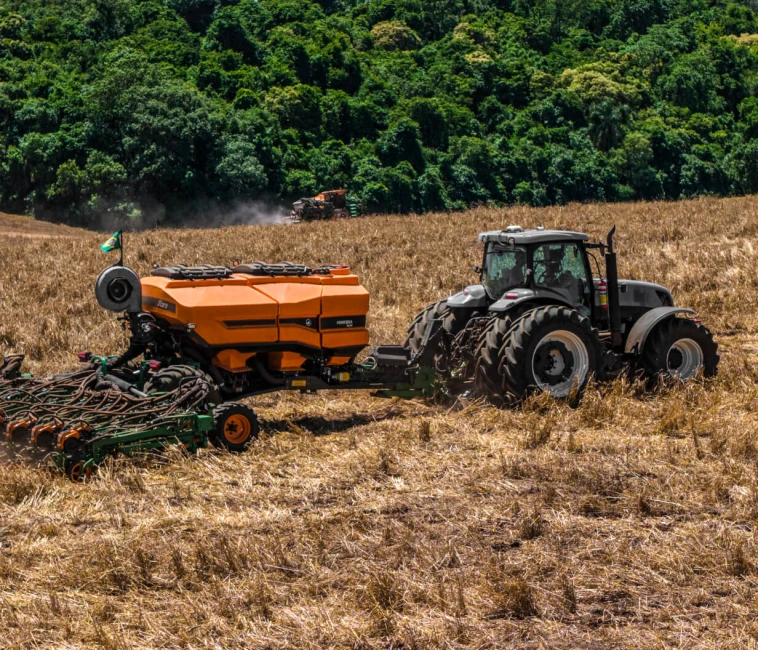
Planters are designed for crops that require precision in the individual distribution of seeds, such as soybeans, maize, beans, and cotton. They use metering devices that deposit each seed separately in the furrow, in accordance with the population, plant spacing, and depth specified in the agronomic planning.
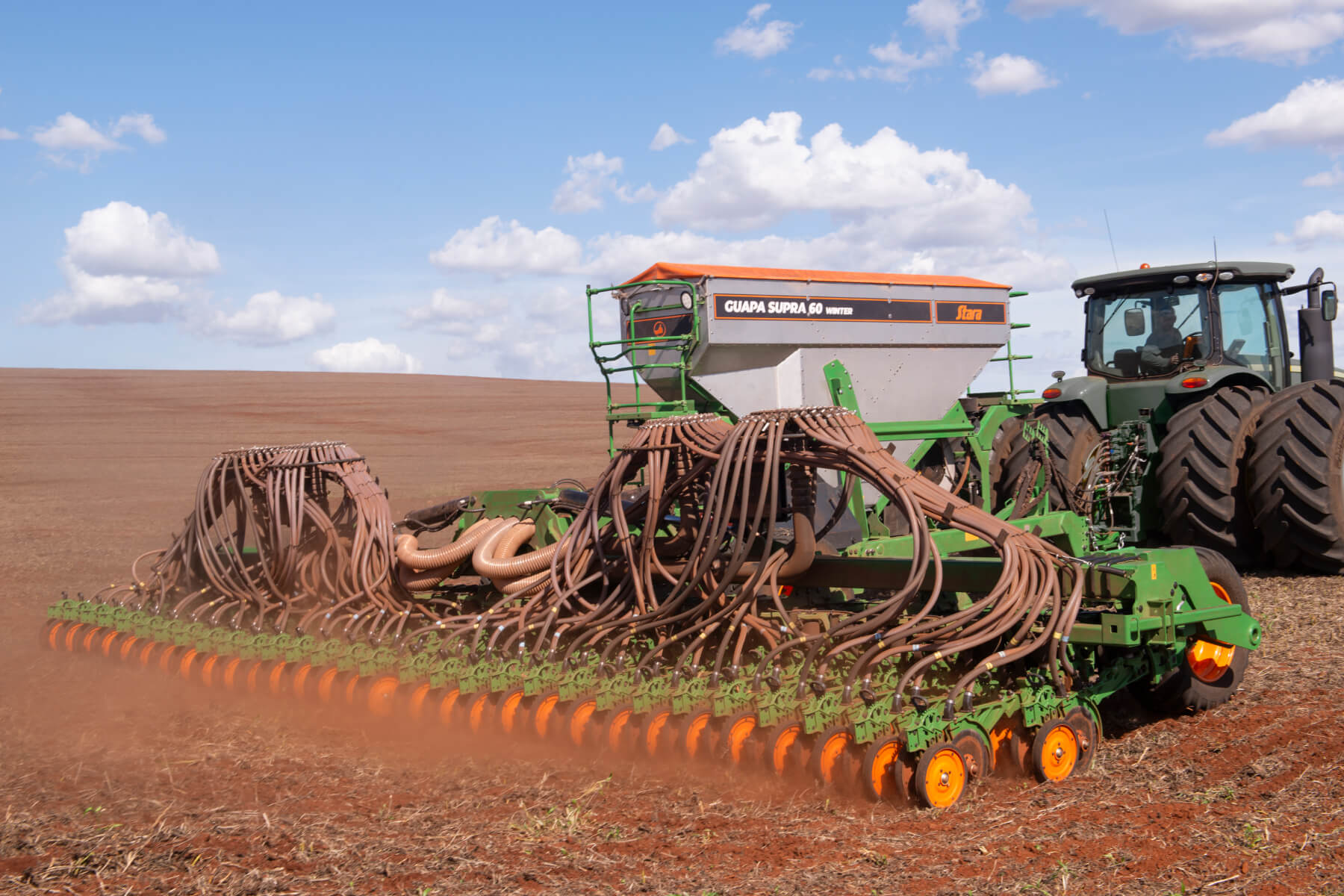
Seeders, on the other hand, are primarily intended for small-seed and forage crops, such as wheat, oats, rye, ryegrass, forage radish, and vetch. In these, distribution occurs continuously along the sowing line, with priority given to achieving the recommended plant population for each crop.
At Stara, for example, the Absoluta, Princesa, Estrela, Cinderela and Eva planters have been developed for summer crops that require high precision in seed placement. Seeders from the Guapa and Guapita line are designed for winter and cover crops, offering suitable metering systems for small seeds and different sowing conditions.
Why should you adjust planters and seeders according to the specific requirements of each crop?
Each crop has its own specific requirements for population, spacing, sowing depth and seed distribution. Therefore, using the same adjustment for different crops may compromise planting uniformity and the productive potential of the farming.
Technical recommendations vary according to the crop. Below, you can see some examples based on research carried out by Embrapa:
- In maize planting, the plant population should be determined according to the cultivar, water availability, soil fertility, sowing time, and the productive potential of the area. In many cases, this population ranges from 30,000 to 90,000 plants per hectare.
- For soybeans, the desired plant population generally ranges from 220,000 to 320,000 plants per hectare and may be adjusted according to the production environment, cropping system, and cultivar characteristics. To achieve this plant population, the planter settings must also include seed germination capacity and vigour.
- In wheat planting, the sowing density depends on the cultivar, the region, the growth cycle, and the intended purpose of the crop. In states such as Rio Grande do Sul and Santa Catarina, it is often recommended to use between 250 and 330 viable seeds per square metre, with spacing of around 17 cm and a depth of 2–5 cm.
Guide to adjusting agricultural machinery according to the specifications of each crop
Before starting field operations, the adjustment must take other factors into account to reduce rework and help the operator verify whether the equipment is delivering the expected performance according to its characteristics.
The main decisions that need to be made before starting grain planting are:
- Crop;
- Planting system;
- Desired plant population;
- Seed characteristics;
- Soil conditions;
- Type of agricultural machine. In general, wheat is sown using seeders designed for fine seeds, while soybeans and maize are planted with seeders developed for larger seeds.
Please see below for more details on each type of adjustment.
How to adjust the planter for the planting of soybeans and maize?
In Stara pneumatic planters, the operator needs to check the metering system, the depth of seed placement, and the pressure applied by the rows, among other adjustments. These adjustments vary according to the model and configuration of the machine, as well as the type of crop and the farming conditions.
Therefore, prior to the planting of soybeans and maize, the following actions must be performed:
- Select the discs and ejectors according to the crop (soybeans or maize);
- Adjust the vacuum level and the pressure of the pneumatic system;
- Set the seed population or rate according to the recommendation for each crop;
- Adjust the sowing depth according to the crop, soil moisture, presence of straw, and agronomic recommendations;
- Adjust the pressure of the seed rows. In the Estrela, Absoluta and Princesa planters, this adjustment is made via the hydraulic system, directly by the Topper 6500;
- When distributing fertilisers, adjust the application rate according to agronomic recommendations;
- In the in-furrow spraying system, if available, adjust the pressure and application rate according to the nozzle and working speed;
- Set a working speed compatible with the conditions of the area and the operational capacity of the machine.
How to adjust the seeder for wheat planting?
For wheat planting, the seeder is adjusted to distribute small seeds at high densities, generally with 17 cm spacing between rows. Therefore, attention should be paid to ensuring a uniform flow, appropriate depth, and correct dosing.
Embrapa recommends a sowing depth between 2 cm and 5 cm for wheat, adjusted according to soil moisture and field conditions, in order to promote uniform crop emergence.
Accordingly, the operator should check the following points on the seeders:
- Seed rate, in kg/hectare;
- Seed placement depth;
- Pressure of the rows, to promote contact between seed and soil;
- Furrow closing, to prevent exposed seeds;
- Seed tubes, ensuring they are clean and free from blockages.
Overview of settings for the planting of soybeans, maize and wheat
Settings for soybeans and maize follow similar principles on planters, with attention to the metering unit, seed population, depth, row pressure, fertiliser distribution, and in-furrow spraying when available. The adjustments should take into account the crop to be implemented, the recommended population and the farming conditions.
Stara planters such as Princesa, Absoluta and Estrela feature resources like Stara Integrated Copying, Stara Electric Metering Unit (DPS-E) with seed rate compensation on curves, and Row-by-Row Shut-Off, as well as the ability to distribute at variable rates and control via the Topper system.
For wheat, sowing requires a different type of agricultural machine. Seeders such as the Guapita and models from the Guapa range work with smaller seeds, distribution via rotors, and reduced spacing between rows. With these machines, the operator must check the seed flow, application rate, depth, and uniformity between rows.
How to calculate seed population?
Before adjusting the planter or seeder, it is necessary to calculate the amount of seed that should be distributed across the area. This calculation can be carried out in seeds per metre or in kg/ha, depending on the crop and the equipment used.
Furthermore, the calculation should include the germination potential, vigour, and the agronomic recommendation for the cultivar. See below for some simplified examples, assuming 100% germination, for educational purposes only.
Example calculation for soybean planting:
- Target population: 280,000 seeds per hectare;
- Spacing: 0.45 m;
- Calculation: 280,000 × 0.45 ÷ 10,000 = 12.6 plants per metre.
Example calculation for maize planting:
- Target population: 70,000 plants per hectare;
- Spacing: 0.45 m;
- Calculation: 70,000 × 0.45 ÷ 10,000 = 3.15 plants per metre.
Example of a calculation for wheat planting:
Target density: 300 seeds per square metre.
Thousand grain weight of the batch (example): 35 g.
Calculation: (300 × 35) ÷ 100 = 105 kg/ha (assuming 100% germination).
Planters, seeders, and precision agriculture
Precision agriculture has made planting more accurate by integrating machinery, electronic systems and agronomic information into a single operation. On planters and seeders, this not only allows parameters to be adjusted according to the characteristics of the area, but also reduces operational errors and enables monitoring of the machine’s performance during operation.
On Stara machines, onboard technologies assist the operator from operation setup through to result monitoring. The Topper allows you to configure parameters such as seed population, fertiliser rate, and row pressure (in compatible models), as well as to control precision agriculture features during planting.
Another distinguishing feature is the DPS-E (Stara Electric Precise Dosing), which ensures uniform distribution, prevents double-seed deposition and failures in planting, and automatically compensates the seed rate on curves.
Stara planters can also benefit from features such as Row-by-Row Shut-Off, which automatically interrupts seed placement in already planted areas, reducing overlaps and generating savings. The Zero Damage system, in turn, automatically switches off the planter toolbars at the exact spot where sprayers and distributors travel, reducing crop damage in subsequent operations.
Stara Technologies for Precision Agriculture
Factory-calibrated Stara Planters with Land Space
Land Space also streamlines the preparation of Stara planters before the start of planting. After all, machines integrated into the technology ecosystem already leave the factory with Row-by-Row Shut-Off and Zero Damage calibrated. Thus, these features are ready for use before the start of operations, offering greater convenience to the operator, reducing machine setup time, and contributing to a more efficient operation.
Available for the Princesa, Estrela and Absoluta planters, Land Space combines technologies that enhance precision, connectivity and management of agricultural operations. Stara Connectivity uses high-speed, low-latency satellite internet to keep machines connected even in remote areas. The Paid Signal provides signal correction to increase positioning accuracy during operations, while Syncro Net enables machines with the same function to work synchronously within the same field, reducing overlaps, operational failures, and wastage of inputs.
The ecosystem also features Telemetria Stara, which provides data, performance reports and real-time maps of operations, as well as Stara Machine Monitoring System, responsible for continuously tracking machine performance and issuing alerts when any parameter is outside the configured standard.
The connectivity provided by Land Space also strengthens technical support through Conecta Stara. With the operator's authorisation, factory technicians can remotely access the Topper controller to carry out diagnostics, provide guidance on calibrations, adjust settings, and assist in solving any potential issues. In practice, this reduces the need to travel to the property, decreases machine downtime, and makes after-sales support more agile and efficient.
Other important precautions besides adjustment
The adjustment of the planter or seeder should be accompanied by regular inspections, preventive maintenance, and cleaning of the components. Before planting, it is recommended to verify the general condition of the machine and check:
- Wear of the cutting discs;
- Integrity of the seed delivery tubes;
- Cleaning of the metering units;
- Condition of rubbers, seals and ejectors;
- Operation of the seed and fertiliser sensors;
- Configuration of the agricultural controller;
- Lubrication as specified in the machine manual;
- Tyre pressure and machine levelling.
After these checks, it is recommended to carry out a final inspection of the adjustments and a functional test before the start of planting. In case of doubt regarding adjustment, parameter settings or preventive maintenance, the operator should consult the technical manual, request remote support, or speak to a Stara specialist at the dealership nearest to their location.
Another important tip is to access the Stara Operator Portal. Available via web portal and app, this platform provides free access to educational content, detailed videos, and explanatory materials about Stara machines and technologies.
Preparing for efficient grain planting begins with the adjustment of planters and seeders.
Correctly adjusting the planter or seeder means setting the machine to meet the requirements of each crop, validating the adjustments in the field, and continuously monitoring the quality of the distribution.
When adjustment, preventive maintenance and precision farming technologies work together, this results in more planting agility for the operator and higher farming uniformity.
Discover Stara agricultural machines designed for different planting systems and find the most suitable solution for your farm.
Discover Stara's full range of agricultural machinery
Frequently asked questions about adjustment of planters and seeders
What is the difference between a planter and a seeder?
The main difference lies in the type of seed that will be used. A seeder handles small seeds such as wheat, oats and rice in a continuous flow. Planters, on the other hand, are precision machines for larger seeds such as soybeans, maize and cotton that place each seed individually at uniform spacing and depth.
How can I tell if the planter is properly calibrated?
The adjustment is correct when the machine delivers the planned population, maintains uniform depth, distributes the seeds without doubles or misses, applies fertiliser according to the recommended rate, and preserves consistency between rows.
Do I need to adjust the planter every time I change the seed batch?
Stara planters equipped with DPS-E use a specific disc for each crop, eliminating the need for replacement with each new batch.
Does precision agriculture replace manual adjustment?
Precision agriculture complements machine adjustment by offering features such as variable rate, section control, operation monitoring, and data management. However, adjustments related to the crop and working conditions, such as seed population, sowing depth, row pressure and fertiliser dosage, remain fundamental to the quality of planting.
How can the planting speed of the machines be adjusted?
The planting speed must meet the recommendations of the manufacturer, the type of crop, and the conditions of the area. During operation, it is important to check whether the speed used maintains the uniformity of seed distribution, the depth of placement, and the proper closing of the furrow. If the quality of planting is compromised, the speed must be adjusted.
Where can I find guidance on adjusting Stara machinery?
The operator can consult the equipment's technical manual, seek specialised assistance at a Stara dealership or through the brand's technical support channels, as well as access the Stara Operator Portal, which was created especially for those who operate Stara equipment.
Looking for solutions to enhance the cultivation of soybeans, maize and wheat on your farm?
Visit a Stara dealership and find the equipment and services best suited to optimise your agricultural production.