


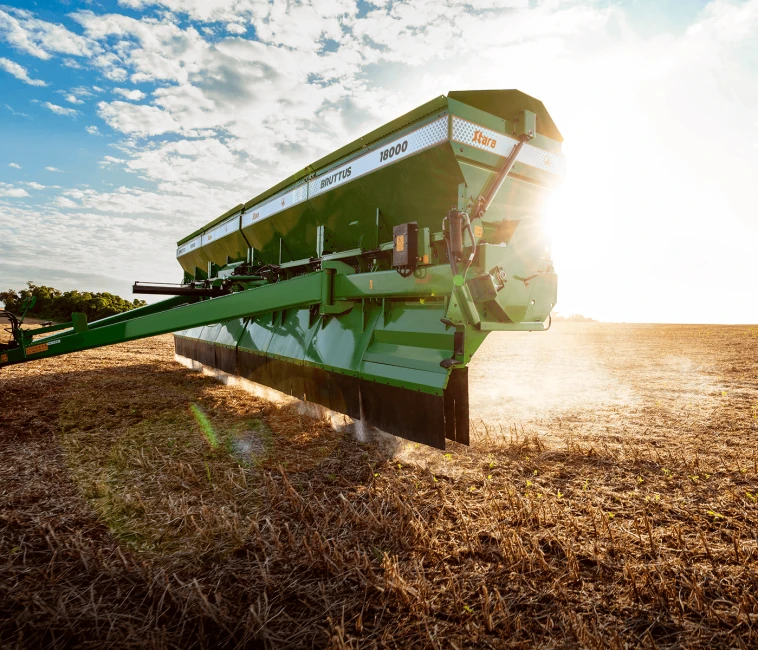
Soil acidity directly affects fertility, root development and nutrient uptake. According to Embrapa, liming is one of the most effective ways to correct acidity while also increasing calcium and magnesium levels in the soil.
However, correcting soil acidity involves more than simply applying limestone. The process must take account of soil test results, base saturation, the actual lime requirement and even distribution across the field.
In this article, Stara's experts explain what soil acidity is, how to measure soil pH and when to apply limestone. Read on to find out how farm technology can make the correction process more efficient and better aligned with soil health.
What is acid soil?
Soil acidity is determined by the concentration of hydrogen and aluminium in the soil. Soil is considered acidic when its pH falls below the range required by the crop and the cropping system.
This problem is widespread across Brazil's agricultural regions, particularly in areas with high rainfall. Continuous cropping, nutrient removal at harvest and the use of certain fertilisers can all reduce soil pH over time.
As acidity increases, calcium, magnesium and phosphorus become less available to crops. Aluminium toxicity can also increase, restricting root development and reducing the return on inputs.
What are the types of soil acidity?
A chemical soil analysis provides several indicators that show not only whether the soil is acidic, but also how severe the problem is and what needs to be corrected.
Alongside pH, parameters such as exchangeable aluminium and H+Al (hydrogen plus aluminium) allow the different types of acidity in the soil to be assessed. As Embrapa points out, this broader interpretation prevents decisions from being based on pH alone and allows a more accurate lime recommendation.
Active acidity
Active acidity is measured by pH. It indicates the concentration of hydrogen in the soil solution and provides an initial assessment of the chemical condition of the field.
Exchangeable acidity
Exchangeable acidity is caused mainly by aluminium held at the soil exchange sites. This aluminium can damage roots and restrict the uptake of water and nutrients.
In crops that are sensitive to acidity, exchangeable aluminium requires particular attention, as damage can occur before the plant shows clear signs of nutrient deficiency.
Reserve acidity
Reserve acidity includes both hydrogen and aluminium and is normally reported as H+Al. It indicates the reserve of acidity that the soil may release over time.
This value is therefore essential for calculating the lime requirement using the base saturation method. Without it, the recommended application rate may be lower than the field actually requires.
How does chemical soil analysis identify low-pH soil?
Chemical soil analysis is the starting point for any well-planned correction of soil acidity. It shows whether the field requires limestone, which soil layer is limiting and what other factors need to be addressed as part of the liming process.
Poor sample distribution, an incorrect sampling depth or combining samples from different areas can produce unreliable results. The farm should therefore be divided into zones with similar cropping histories, topography, productivity and management practices.
A soil analysis will typically assess:
- pH;
- exchangeable aluminium;
- calcium;
- magnesium;
- potassium;
- H+Al;
- CEC;
- base saturation;
- aluminium saturation;
- organic matter.
Together, these indicators show whether the acidity is confined to the surface layer or extends deeper into the soil profile, and whether the field has a slight reduction in pH or a more serious constraint on root development.
How is soil acidity measured?
Laboratory soil analysis is the most reliable method.
pH meters can provide quick readings in the field, but they are no substitute for a complete soil analysis. To plan the correction properly, indicators such as pH, aluminium, H+Al, CEC and base saturation must be considered together.
For sound agronomic decision-making, the recommended approach is to:
- collect representative samples from each field;
- have the samples analysed in a laboratory;
- interpret the results with the support of an agronomist;
- take the field's yield history into account;
- use soil and application maps where available.
With this information, the farm can avoid making decisions based on isolated pH readings and plan the correction with greater confidence.
Base saturation is central to correcting soil acidity
Base saturation, also known as V%, indicates the percentage of the CEC (Cation Exchange Capacity) that is occupied by bases such as calcium, magnesium, potassium, and sodium.
When base saturation is low, hydrogen and aluminium occupy a greater proportion of the soil's CEC, indicating higher acidity and a need for correction. This is particularly important for crops that require favourable soil chemical conditions to reach their yield potential.
According to Embrapa, the base saturation method uses the CEC, the current base saturation and the target base saturation to calculate the lime requirement.
The resulting lime requirement varies according to the crop, region, management system and agronomic recommendations followed. The results should therefore be interpreted with guidance from an agronomist, taking account of both the laboratory report and the specific conditions in each part of the field.
6 common problems caused by soil acidity
The effects of soil acidity depend on the crop, soil texture, management system and the severity of the problem shown by the soil analysis. The main problems are:
- Restricted root growth: excessive acidity restricts root development, reducing the plant's ability to explore deeper soil layers for water and nutrients.
- Reduced nutrient availability: in acidic soils, nutrients such as calcium, magnesium and phosphorus become less available to the crop, limiting growth and affecting crop nutrition.
- Increased risk of aluminium toxicity: in acidic conditions, aluminium can reach toxic levels and severely restrict root development.
- Reduced fertiliser efficiency: poor nutrient uptake reduces the crop's response to applied fertiliser and lowers the return on inputs.
- Uneven crop development: crop growth, vigour and yield can vary considerably across the same field.
- Lower yield potential: soil acidity can reduce yield per hectare and, ultimately, farm profitability.
What is liming and how does it correct soil acidity?
Liming is the application of limestone to correct soil acidity, reduce the effects of exchangeable aluminium and supply calcium and magnesium to plants.
According to a study carried out as part of the agronomy programme at IFSul, liming improves soil chemical conditions, encouraging root growth and improving crop response to soil fertility management.
In fields with a very low pH, fertiliser may deliver only a limited return because nutrient availability and uptake are restricted. Liming helps create the soil conditions needed for crops to respond more effectively to fertiliser.
When properly planned, limestone application promotes a more active and evenly distributed root system. This allows plants to make better use of water and nutrients, improving nutrient use efficiency.
How does limestone correct soil acidity?
Limestone is one of the main materials used to correct acidic soils. It raises soil pH, reduces aluminium toxicity and improves nutrient availability to plants.
The choice of limestone should be based on its calcium and magnesium content, particle size, PRNT, soil type and the lime requirement identified by the soil analysis. These factors help determine the most suitable product and avoid blanket applications that may reduce the effectiveness of liming.
When applied at the correct rate and spread evenly, limestone creates more favourable soil chemical conditions for root growth and helps crops make better use of applied fertiliser.
How can farm technology help correct soil acidity?
Farm technology helps turn agronomic recommendations into precise applications in the field while supporting soil health. In soil acidity correction, this may involve soil analysis, prescription maps, rate controllers and variable-rate application.
The process begins with the collection and interpretation of soil analysis data. This information is then used to produce prescription maps, allowing each part of the field to be treated according to its lime requirement.
During variable-rate application, the rate controller automatically adjusts the limestone application rate according to the prescription map. Areas with a greater lime requirement receive more limestone, while those with a lower requirement receive less. The aim is to match limestone application rates to soil variability.
Topper: map-based application
Topper is Stara's precision farming controller for functions such as GPS guidance, variable-rate application, auto section control, tramlines and auto steering.
When working from prescription maps, it helps the operator apply the rate specified for each management zone.
The functions available depend on the machine and the version and configuration in use. On lime spreaders, integrating the prescription map with the rate controller enables more precise application according to the requirements of each area.
Telemetry and application monitoring
During application, Stara Telemetry allows the operation to be monitored in real time from an internet-connected device. It provides information on the machine and the work being carried out, including the route travelled, system alerts, operating time, fuel consumption, speed and work rate.
This supports better farm management by allowing the planned operation to be compared with the work actually carried out.
When correcting soil acidity, it also creates a field-by-field record of applications, helping to inform soil fertility decisions in future seasons.
Why spreader choice matters for application uniformity
The choice of spreader has a direct bearing on the uniformity and accuracy of limestone, fertiliser and other solid product applications. Stara's Bruttus and Hércules ranges meet different spreading requirements and include features that support uniform application, accurate rate control and more efficient use of inputs.
Bruttus spreader
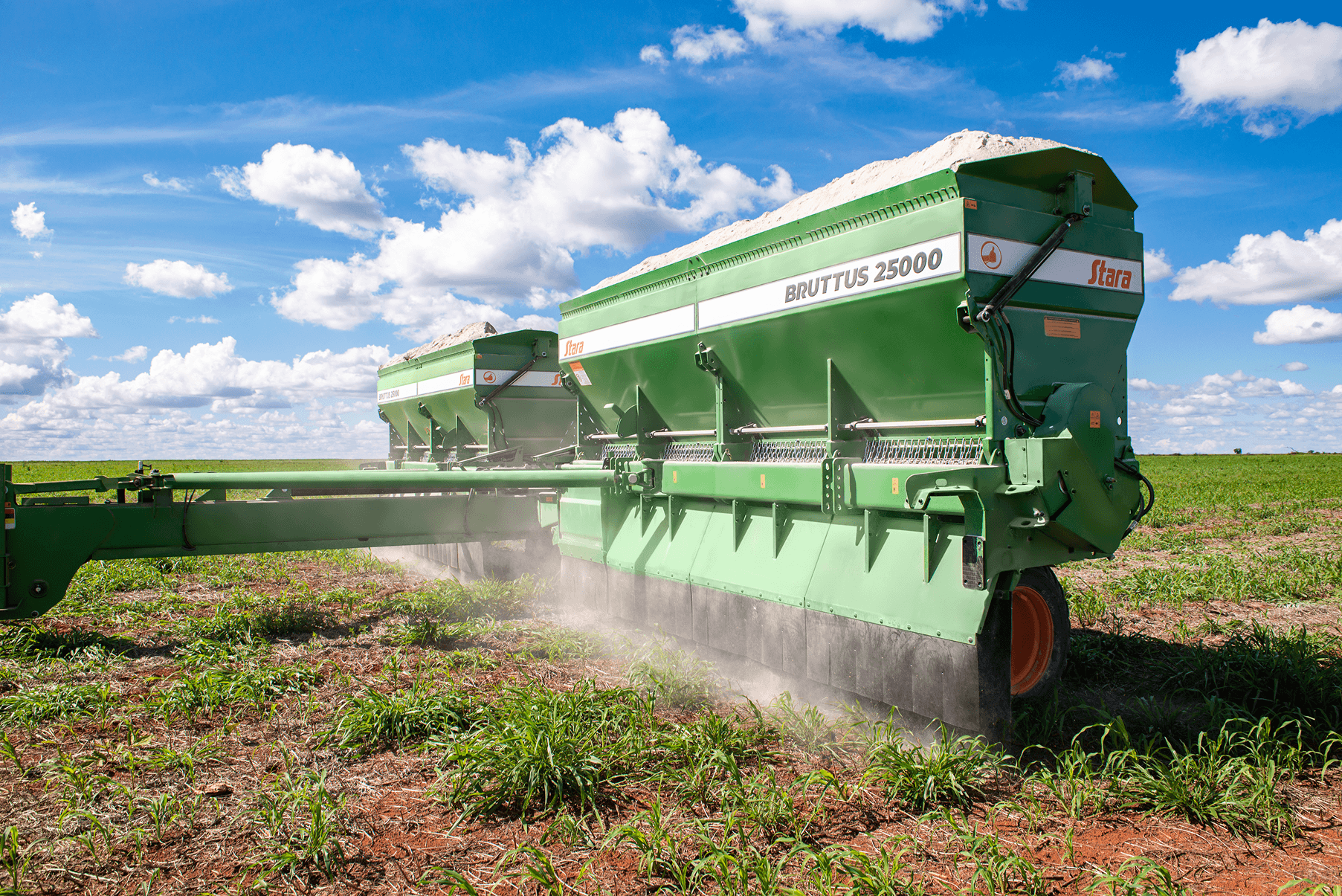
Bruttus is a trailed gravity-feed spreader for powdered products such as limestone. Available in 25000, 18000 and 12000 models, it is designed to deliver uniform spreading with a low coefficient of variation. Key features include:
- 24° articulation, providing 12° of upward and 12° of downward movement for improved ground following;
- Individual section shut-off to minimise overlap;
- Tipping hopper with side and front panels;
- Internal agitators;
- Rubber conveyor belt with an internal scraper;
- Variable-rate application on compatible versions;
- Articulated chassis to reduce transport width.
Hércules spreaders
The trailed Hércules range comprises high-output broadcast spreaders designed for accurate rate control. Suitable for spreading soil amendments, fertiliser and seed, the Hércules 24000, 15000 and 10000 models feature a stainless steel hopper, Dual Feedgate with flow divider, deflector, straightforward calibration, application rate controller and precision farming technologies.
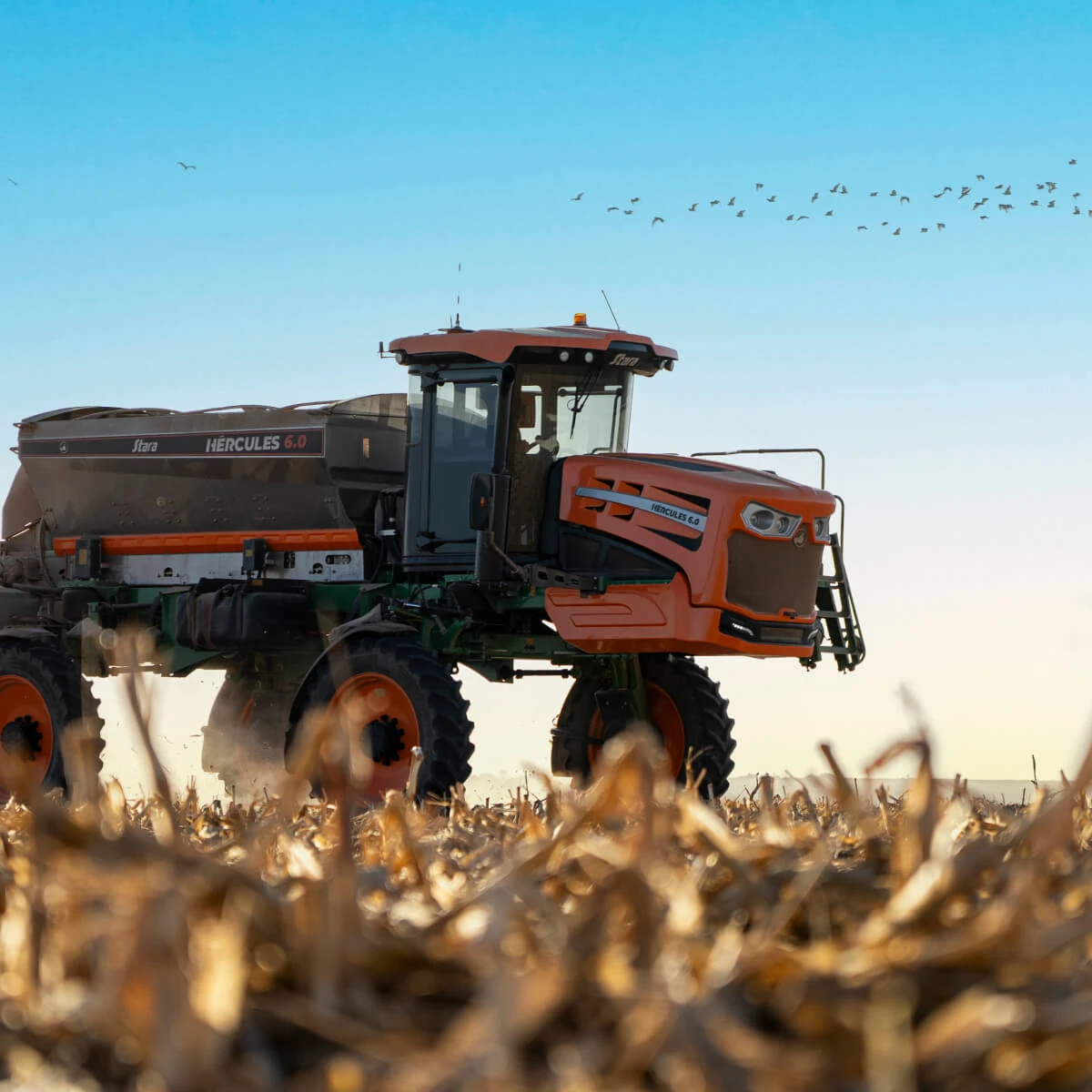
The self-propelled Hércules 4.0, Hércules 6.0 and Hércules 9.0 models are designed primarily for fertiliser application. They offer high ground clearance, high output and an electronic weighing system that monitors the amount applied. The right model will depend on the product being applied, the agronomic recommendation and the operational needs of the farm.
Effective soil acidity correction supports higher yields
Correcting soil acidity with limestone requires accurate diagnosis, sound agronomic advice and effective application.
Stara machinery and technology help improve application accuracy and uniformity, allowing inputs to be used more efficiently and helping crops reach their yield potential.
Frequently asked questions about correcting soil acidity
How can soil acidity be corrected?
The process starts with soil analysis, interpretation by an agronomist and calculation of the lime requirement. The next steps are to select the right type of limestone, choose the most suitable time for application and ensure it is spread evenly across the field.
How is soil acidity measured?
Laboratory soil analysis is the most reliable method. Although pH indicates active acidity, liming decisions should also take account of exchangeable aluminium, H+Al, CEC, base saturation and aluminium saturation.
When should limestone be applied?
The timing depends on the cropping schedule, the management system, whether the limestone needs to be incorporated into the soil and how long it will take to react. As limestone takes time to react in the soil, it should be applied well in advance.
What is the correct limestone application rate?
There is no single standard rate. The amount required depends on the soil analysis results, current and target base saturation, CEC, the soil depth used in the calculation, the type of limestone and the management system. Applying too little may leave the soil acidity only partly corrected. Applying more than recommended can cause nutrient imbalances and raise the pH beyond the level required by the crop.
What types of limestone are used to correct soil acidity?
The three main types are calcitic, magnesian and dolomitic limestone. Their chemical composition and particle size affect how quickly they react and how effectively they work in the soil.
Can limestone be applied at a variable rate?
Yes, where prescription maps are available and the machine is compatible. Variable-rate application allows the rate to be adjusted to the requirements of each management zone, improving the accuracy of the correction..
Why is uniform limestone application important?
Uniform spreading helps ensure that each part of the field receives the correct amount of limestone. An uneven spread can leave areas with high acidity, restricted root growth and a poor response to fertiliser.
What causes uneven limestone spreading?
Uneven spreading may be caused by poor machine setup, caked material, an unsuitable forward speed, an incorrectly set bout width or failure to check the overlap between passes.
Want to apply limestone more accurately?
Visit your local Stara dealer to find the right technology for your operation and help your farming business reach its full potential. Request a quote.