Each field has its own history of pests and diseases, and the right time to intervene depends on crop conditions and the information obtained through field monitoring. In grain crops, biological products have been gaining space within management strategies and can be used in combination with other control methods. However, to achieve the expected results, it is necessary to consider both the characteristics of the product and the conditions under which the application is carried out.
Biological products display characteristics that vary according to the agent used and its formulation. In the case of products based on microorganisms, factors such as temperature, solar radiation and spray mixture characteristics may interfere with the viability and performance of the biological agents. Therefore, in addition to selecting the appropriate product and intervention timing, proper storage, spray mix preparation and spraying practices are essential for treatment efficiency.
The following sections present the main precautions required at each stage, from storage to performance evaluation, and explain how Stara sprayer technologies can contribute to application control, spray distribution uniformity and compliance with operational parameters.
What Is the Role of Biological Products in Pest and Disease Management?
Biological control in agriculture uses organisms such as fungi, bacteria, viruses and natural enemies to act against pests and disease-causing agents. This strategy is part of Integrated Pest Management (IPM) and integrated disease management, expanding control alternatives and contributing to a reduction in the use of certain chemical pesticides.
The selection of the product and the timing of application must take into account crop monitoring, identification of the target organism, conditions favourable to its development and technical recommendations. Depending on the biological agent used, the treatment may be preventive or may be applied after the identification of a pest or disease, always respecting the usage guidelines and conditions established on the product label.
Among the agents used in biological control are microbiological and macrobiological agents, which have different characteristics and application methods. According to Leonardo Seibel Sander, Stara Product Marketing Coordinator, the difference between these groups is directly related to the choice of management strategy:
In general, the classification between microbiological and macrobiological agents is related to the size of the organisms. Microbiological agents are not visible to the naked eye, whereas macrobiological agents can be observed without specialised equipment. The use of each group depends on the target that needs to be controlled.
Microbiological agents include bacteria, fungi and viruses, which act through different mechanisms of action. Macrobiological agents include parasitoids and predators, such as wasps of the genus Trichogramma, which are used to control the eggs of certain agricultural pests.
In pest and disease management, microbiological products include biofungicides and bioinsecticides. Some biofungicides contain bacteria capable of producing metabolites, substances resulting from biological activity that can inhibit the development of disease-causing microorganisms in plants.
Among bioinsecticides, formulations based on baculoviruses stand out. These viruses infect specific pest insect species, especially caterpillars. Entomopathogenic fungi are also widely used because they cause infections in target insects, helping to control their populations. The application method also varies according to the biological agent used. While certain microbiological products are formulated for spraying applications, macrobiological products generally require specific field-release methods.
Within the group of microbiological products applied through agricultural spraying, biofungicides and bioinsecticides are available in commercial formulations such as wettable powder (WP), suspension concentrate (SC) and oil dispersion (OD). Each formulation requires specific precautions regarding the order of addition to the tank, mixing time and the physical-chemical compatibility of the spray mixture.
Before Application: How to Store Biological Products
Application quality begins before the sprayer enters the field. Biological products, particularly those based on entomopathogenic fungi, bacteria or viruses, require careful storage and transport procedures to preserve their characteristics and field performance.
Exposure to unsuitable temperatures and direct sunlight may compromise microorganism viability or product stability, depending on the biological agent and formulation. When these characteristics are damaged during storage, even a well-executed application may fail to deliver the expected results.
For this reason, storage conditions must follow the manufacturer's recommendations. Some products require refrigeration, while others may be stored at ambient temperature provided that the limits established for each formulation are respected.
Once proper storage has been ensured, attention should shift to spray mixture preparation, where water quality and interactions between components also influence biological product performance.
During Preparation: Water Quality and Spray Mixture Quality
During the preparation of the spray mixture, it is recommended to assess the quality of the water being used, as its physical and chemical characteristics may influence the performance of biological products.
In this process, three factors deserve attention before the biological product is added:
Water pH, which indicates its acidity or alkalinity;
Water hardness, related to the concentration of minerals such as calcium and magnesium;
The presence of residues from products previously used in the sprayer tank.
This precaution is important because alkaline or excessively acidic water may inactivate bacteria and viruses or cause the breakdown of suspensions. In addition, residues of chemical fungicides or bactericides within the self-propelled sprayer system may render the biological load ineffective.
Leonardo Seibel Sander, Stara Product Marketing Coordinator, provides an example:
Water quality must be suitable for the characteristics of the products being used. In the case of applications involving baculoviruses, for example, the recommendation is to work with a non-alkaline spray mixture pH.
As suitable conditions vary according to the product and formulation, any adjustments to water quality should follow the recommendations provided on the label and by the manufacturer.
From Tank to Target: How Does Sprayer Calibration Favour Biological Applications?
In the field, sprayer calibration and environmental conditions are fundamental to application quality, regardless of the type of product being used. Parameters such as application rate, boom height and travelling speed must be defined according to technical recommendations, taking into account the characteristics of the product and the intended target.
For biological products, some aspects require special attention, particularly when formulations contain suspended particles. In these situations, appropriate filter screen selection and cleaning of the spray circuit are essential to prevent nozzle blockage and possible variations in flow rate along the boom.
The choice of spray nozzles and adjustment of operating pressure also influence droplet size, which must provide adequate coverage without increasing the risk of drift. Very fine droplets are more susceptible to evaporation and wind displacement, while excessively coarse droplets may compromise coverage, especially on small or difficult-to-reach targets.
Leonardo Seibel Sander, Stara Product Marketing Coordinator, emphasises that nozzle selection and operating pressure adjustment must follow agronomic recommendations, taking into account the product and application target:
The application of biological products using Stara sprayers does not require exclusive machine adjustments. Spraying parameters should follow technical recommendations while respecting formulation characteristics and working conditions.
Just as calibration is important, environmental conditions must also be evaluated. High temperatures, low relative humidity and intense UV radiation can compromise certain biological agents. For this reason, it is essential to follow the recommendations stated on the product label.
Regarding the most suitable periods for applications carried out exclusively with biological products, the specialist advises:
When an application consists solely of biological products, priority should be given to the coolest hours of the day, when humidity levels are higher and temperatures are lower. Night-time is the most recommended period because product performance does not depend on interaction with solar radiation.
Once the parameters have been defined by the responsible agronomist, calibration of the self-propelled sprayer ensures that spray volume, operating pressure and travelling speed remain within the recommended specifications.
Can Biological Products Be Mixed with Chemical Crop Protection Products?
Mixing biological products and chemical crop protection products in the same tank may offer an alternative for optimising field operations. However, not all combinations are compatible, making technical assessment necessary before preparing the spray mixture.
Compatibility must be evaluated from three perspectives:
Physical compatibility – absence of clumping or flocculation;
Chemical compatibility – stability of molecules;
Biological compatibility – maintenance of the viability of living organisms.
Even when the spray mixture appears homogeneous, this does not guarantee that the microorganisms remain active.Leonardo Seibel Sander explains how this interaction can compromise biological control:
When certain fungicides are combined with fungal-based biological products, depending on the active ingredients and formulations involved, antagonism may occur, compromising the activity of the microorganism responsible for control.
Antagonism occurs when the action of one product negatively interferes with the activity of another. Therefore, before carrying out any mixture, it is important to consult product labels, compatibility information provided by manufacturers and the recommendations of the responsible agronomist.
A jar test may be used to verify the physical compatibility of the spray mixture, while the preservation of biological activity should be confirmed through the technical recommendations of each product.
Stara Technologies That Contribute to Spray Quality
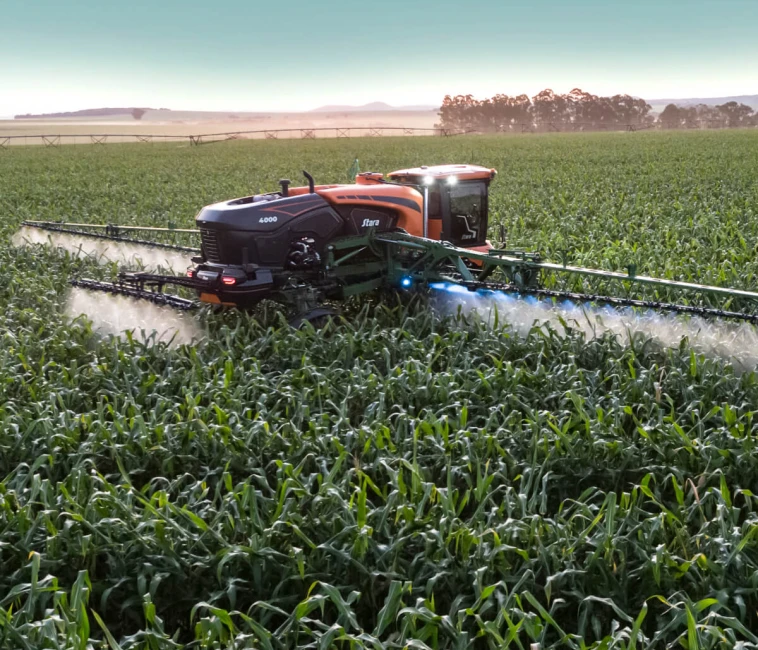
Stara develops its sprayers based on the needs of field operators. Technologies such as Nozzle-by-Nozzle Control, the Continuous Recirculation System, and the Dual Line System help reduce overlaps, preserve spray homogeneity and maintain application quality across different operating speeds.
The availability of each feature varies according to the model and configuration of the Stara sprayer.
- Nozzle-by-Nozzle Control System: This system automatically shuts off each spray nozzle when the Topper identifies an area where the spray mixture has already been applied, such as headlands and field boundaries. Individual nozzle control reduces overlap and prevents product waste.
- Continuous Recirculation System: The spray mixture remains in constant circulation throughout the tank and pipework, including during spraying interruptions. This movement promotes mixture homogeneity and maintains uniform product concentration during application. It also contributes to circuit cleanliness and component durability.
- Dual Line System: The Dual Line System features two spray nozzle lines that can operate alternately or together, enabling applications across a wider range of travelling speeds.This configuration improves operational efficiency and allows work to be carried out at suitable pressures, contributing to more uniform droplet sizes and reducing drift risk.
Post-Application Monitoring
Monitoring after application makes it possible to evaluate the treatment response and track the development of pests and diseases in the crop. This assessment must take into account the action time of the biological agent used, as certain microorganisms need to infect and develop within the target organism before results can be observed.
To relate field results to the conditions under which the treatment was carried out, it is advisable to maintain an application record containing:
- Field identification, product, formulation and dose used;
- Date, time and environmental conditions, such as temperature, relative humidity and wind speed;
- Spray volume, nozzle type and operating pressure.
Analysis of this information, together with crop monitoring data, helps the responsible agronomist evaluate the response to treatment and determine whether further interventions are necessary. In this way, biological control remains integrated with other pest and disease management strategies.
From Storage to Target: Every Stage Preserves the Biological Product
Biological products expand the possibilities for pest and disease management in grain crops, but their performance depends on precautions that begin before spraying and continue after the operation has been completed. Product preservation, spray mixture preparation and the selection of appropriate environmental conditions for application are all factors that must be considered in order to maintain the characteristics of biological products and support treatment efficiency in the field.
Within this process, having a well-calibrated sprayer equipped with technologies suited to the operation also makes a significant difference. Stara sprayers combine solutions that contribute to application quality while meeting the diverse needs of crop production.
Discover the Stara agricultural sprayer range and visit your local dealership to learn about the configurations available for each model.
Frequently Asked Questions About Biological Products in Agriculture
Why Is Proper Storage Important for the Efficiency of Biological Products?
Proper storage preserves product stability and, in formulations containing living microorganisms, maintains the viability of the biological agents. Respecting the temperature requirements and light-protection conditions specified on the label and product information is essential to preserve product characteristics until the moment of application.
Can the Water Used in the Spray Mixture Affect Application Quality?
Yes. Factors such as pH, hardness, temperature and the presence of certain substances in the water can interfere with the stability of biological formulations and the activity of sensitive microorganisms. For this reason, water quality must comply with the specific recommendations provided for the product being used.
How Can the Success of a Biological Product Application Be Evaluated?
Evaluation should be based on regular field monitoring after application, while respecting the action period required by each biological agent. Records of spraying conditions help the responsible agronomist relate treatment execution to the results observed in the field and also support future management decisions.
Count on Stara for Spraying Your Crop
Speak with our technical specialists and find the machine best suited to the operations of your farm.
Send us your message here.