


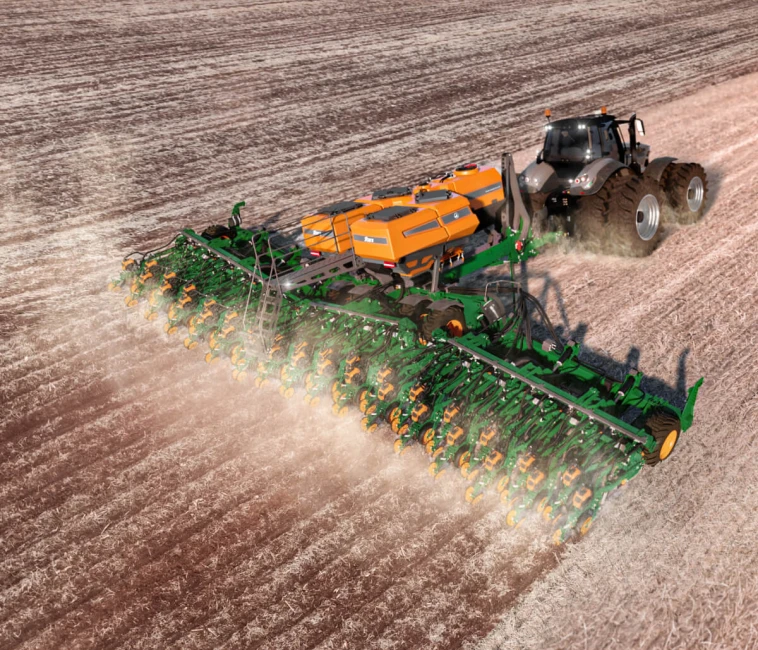
A good seed distribution is essential for establishing a uniform crop. To achieve this, the planter must deliver the planned population and maintain consistent spacing between seeds along each row.
Misses and doubles may occur when seed distribution is compromised, while overlaps occur when seeds are deposited in areas that have already been planted. Although these situations are different, all three can affect crop uniformity and development.
To maintain the planned distribution, attention begins with correct planter adjustment and verification of the seeds placed in the furrow. In Stara planters, technologies such as DPS-E and Row-by-Row Shut-Off complement this process, contributing to greater planting accuracy.
Below, learn what causes misses, doubles and overlaps, how these occurrences affect the crop, and which practices and technologies help prevent them.
What Can Cause Misses, Doubles and Overlapping During Planting?
In seed distribution, a miss occurs when no seed is placed where one should have been deposited, whereas a double occurs when two seeds are placed too close together. Several factors can compromise this uniformity, including:
- improper meter feeding;
- incorrect vacuum adjustment;
- a disc or singulator incompatible with the crop;
- planting speed unsuitable for field conditions; among other factors.
After emergence, however, the absence of a plant in a particular location does not necessarily mean that a distribution miss occurred. The seed may have been deposited but failed to germinate, or the seedling may not have emerged successfully. Therefore, stand assessment should consider other factors such as planting depth, soil moisture, seed-to-soil contact and seed lot quality.
Overlap, on the other hand, occurs when one or more planter rows deposit seeds in an area that has already been planted. This situation is more common in headlands, field borders and pass intersections. Without individual row control, part of the machine may continue releasing seeds in an already planted area, while the remaining rows move across an area that still requires planting.
How Do Misses, Doubles and Overlaps Affect Planting?
Although they have different causes, misses, doubles and overlaps alter the way plants occupy the field. In the case of misses, the absence of seeds in certain spaces may reduce the planned plant population. With doubles, two seeds placed very close together reduce the space available for plant development.
Matheus Henrique Baumgratz, Agronomist and Product Marketing Analyst at Stara, explains the effect of this proximity:
"Double seeds occur when seeds are deposited at very short intervals, resulting in plants growing too close together and increasing competition for essential resources such as nutrients, water and light. Likewise, overlapping seeds in an area that has already been planted can increase plant concentration in that location, intensifying competition and potentially compromising plant development."
This distribution must also be analysed according to the characteristics of each crop.
What Changes in Seed Distribution Between Corn and Soybeans?
The number of seeds per metre and the expected spacing between them vary according to the crop and the population established for the field. Therefore, evaluating planting quality requires consideration of the settings adopted for each situation.
Matheus Henrique Baumgratz, Agronomist and Product Marketing Analyst at Stara, provides an example:
"If I programme three corn seeds per metre, I will have approximately 33 centimetres between them. With 12 soybean seeds per metre, that distance is close to 8 centimetres. Therefore, seed distribution must be evaluated according to the seeding rate programmed for each crop."
The values presented correspond to the average expected distance between seeds under these two settings. The population used should follow the planning of each field, taking into account the crop, hybrid or cultivar, and technical recommendations.
For both corn and soybeans, Stara planting solutions allow seed rates to be configured according to the desired population. Once this adjustment has been made, the operator can monitor machine performance during operation and verify whether seed placement is occurring as planned.
How Can Misses and Double Seeds Be Prevented During Planting?
Before entering the field, it is important to check the classification and condition of the seed lot and consult the planter's operator's manual to select the appropriate components and carry out the recommended adjustments for each crop. The condition of the discs, singulators and other components of the metering system should also be inspected, taking into account possible wear, dirt accumulation or incorrect assembly.
During the first pass, one way to assess the result is to open several sections of the furrow and compare the number and spacing of the deposited seeds with the settings entered into the controller. The planting depth should also correspond to the planter's adjustment. This inspection helps identify possible deviations and allows the necessary corrections to be made before proceeding across the field.
Matheus Henrique Baumgratz, Agronomist and Product Marketing Analyst at Stara, recommends monitoring machine performance throughout the operation:
"Vacuum pressure must be correctly adjusted to prevent misses and double seeds. Travel speed also affects seed distribution. Therefore, the operator needs to monitor the information provided by the sensors during planting and verify whether the machine is delivering the programmed population."
Travel speed should balance operational efficiency with planting quality according to the soil, residue cover and terrain conditions of each area. If misses, doubles or irregular spacing are identified, speed and machine settings should be reassessed, followed by a new inspection of the seeds in the furrow.
In Stara planters, the DPS-E performs seed metering and singulation on each row, with individual control of the seed meters to maintain the programmed rate throughout the operation.
How Does Stara's DPS-E Contribute to More Uniform Seed Distribution?
The DPS-E (Stara Electric Seed Meter) uses vacuum pressure to hold the seeds in the holes of the seed disc, which is driven by an electric motor. During rotation, seven double-seed elimination points act on seed singulation, helping ensure that only one seed is released at a time.
The electric drive enables individual control of the meter rotation on each row according to the programmed seed rate. When vacuum pressure and other components are correctly adjusted, the system maintains the desired application rate and reduces the occurrence of misses and double seeds.
The gate regulates the seed level inside the meter, and its opening should be adjusted according to seed characteristics. Larger seeds require a greater opening, while smaller seeds require more restriction, following the recommendations in the operator's manual. This adjustment ensures that the appropriate quantity of seeds is available for the metering mechanism to function correctly.
Curve Compensation
Individual row control also makes it possible to account for differences in travel distance when operating in curves. When turning, the outer rows travel a greater distance than the inner rows within the same period. If all rows released the same number of seeds during that time, seed distribution per metre would differ between the two sides of the machine.
The electric drive allows the rotational speed of each seed meter to be adjusted individually. Outer rows need to deliver more seeds during the same time interval, while inner rows need to deliver fewer. This compensation follows the path travelled by each row to maintain the programmed seeding rate.
Variable Rate, Maintenance and Compatibility
In addition to curve compensation, the DPS-E enables variable-rate seeding. Easy access to the interior of the meter also simplifies cleaning and maintenance, as well as disc and singulator changes when switching between crops.
This technology is available on various Stara planter models, including Estrela, Absoluta, Princesa, Cinderela and Eva, depending on the machine configuration.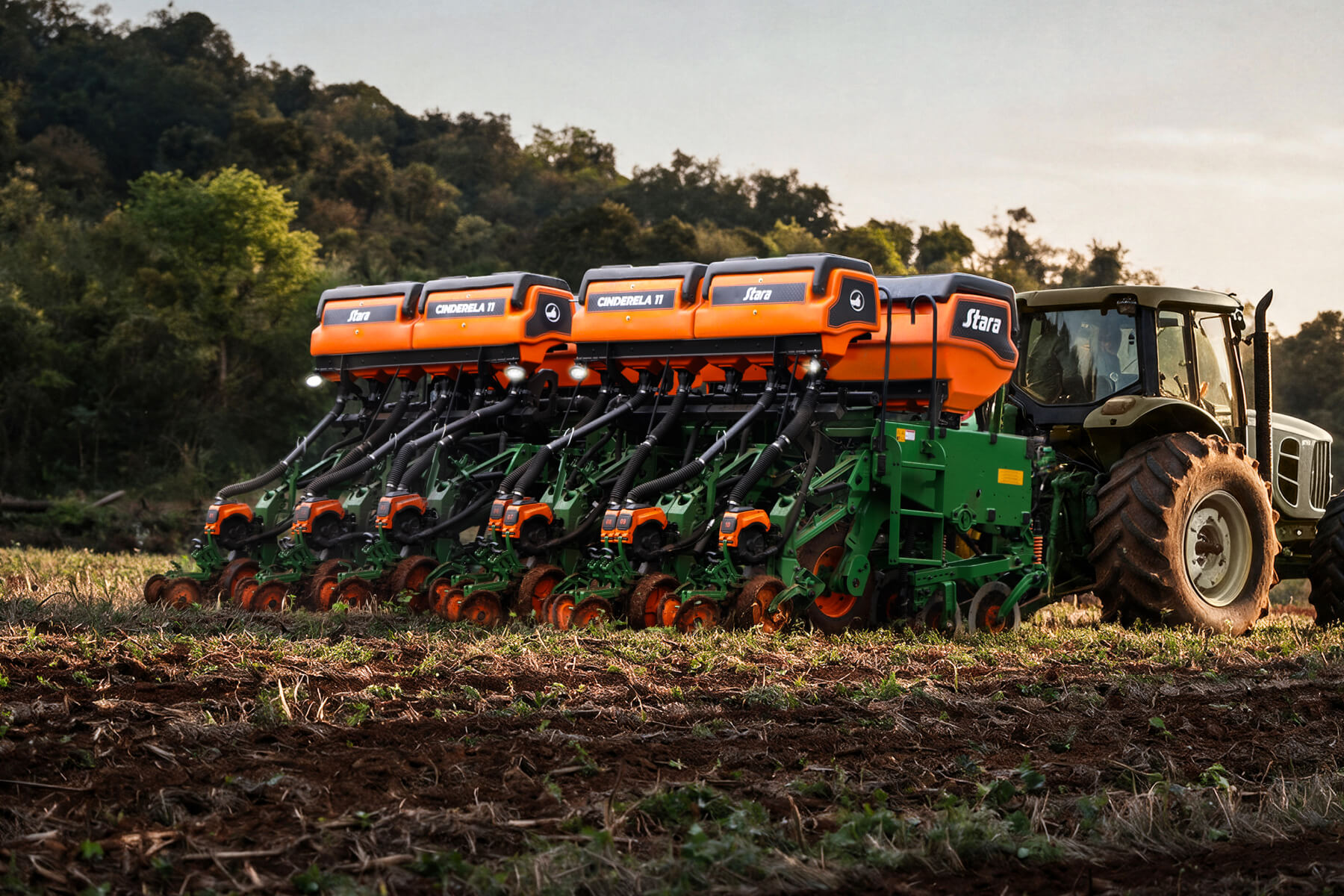
In addition to corn and soybeans, the meter can be configured for beans, cotton, sorghum, millet and canola. For each crop, the corresponding seed disc and singulator must be used.
See also: Precision Agriculture: What It Is and How It Works.
How Does Row-by-Row Shut-Off Prevent Overlaps?
Preventing seed deposition in areas that have already been planted is another important measure for maintaining the planned plant population. Matheus Henrique Baumgratz, Agronomist and Product Marketing Analyst at Stara, explains how the Row-by-Row Shut-Off system works to prevent overlaps:
"Row-by-Row Shut-Off is a technology that enables individual control of seed deposition on each planter row. It prevents seed overlap in areas that have already been planted, maintaining the planned population, reducing unnecessary input application and improving operational efficiency during planting."
This control is particularly important in headlands, field borders and pass intersections. For example, when entering a previously planted area diagonally, one side of the planter reaches the planted zone before the other. The system automatically stops seed metering on the rows that have reached the planted area while keeping the remaining rows operating until they also reach the same point.
Matheus Henrique Baumgratz highlights the impact of this technology on seed consumption:
"With Row-by-Row Shut-Off, average seed savings are around 5%. These savings result from the reduction of overlaps and vary according to the characteristics of each field."
The operation of Row-by-Row Shut-Off depends on proper system configuration and calibration, as well as the correction signal required to accurately identify already planted areas. The availability and configuration of this technology vary according to the planter model and version.
Planters Estrela, Princesa and Absoluta equipped with Land Space leave the factory with the Row-by-Row Shut-Off system already calibrated.
How Can the Cause of the Problem Be Identified in the Field?
In addition to monitoring during planting, crop establishment after emergence provides valuable information about the outcome of the operation. When gaps appear within the row, assessing the area helps determine whether a seed placement miss occurred or whether the seed was deposited but failed to germinate, or the seedling was unable to emerge.
The presence of the seed or its remains in the soil is one of the first aspects to consider. Signs of deterioration or insect damage, as well as planting depth, soil moisture and seed-to-soil contact, all help explain what happened. Therefore, the absence of a plant alone does not necessarily indicate that the planter was responsible for the issue.
These observations can be correlated with the operation history and the information recorded by the controller. The table below summarises some signs that may be observed in the field, their possible causes and the aspects that should be checked before making any adjustments.
|
Observed Sign |
Possible Cause |
What to CheckSeed |
|
Seed placement miss
|
Inadequate meter feeding, incorrectly adjusted vacuum pressure, a seed disc or singulator incompatible with the crop, or unsuitable operating speed.
|
Metering system, target plant population, controller alerts and seed spacing.
|
|
Emergence failure
|
Germination issues, incorrect planting depth, insufficient or excessive moisture, unfavourable soil conditions, or damage caused by pests.
|
Presence and condition of the seed or seedling, planting depth, soil moisture and soil conditions.
|
|
Double seeds
|
Poor singulation, incorrect vacuum adjustment, or a seed disc and singulator not suited to the crop.
|
Vacuum pressure, gate setting, seed disc, singulator and seed spacing.
|
|
Overlap |
Continued seed deposition when a row enters an area that has already been planted.
|
Individual row shut-off, correction signal and system configuration.
|
By relating field observations to what occurred during planting, it becomes easier to identify the source of the problem and prepare for future operations. This assessment connects planter adjustment practices with the results observed in the field.
Planting Quality Begins with Proper Seed Distribution
Planting quality depends on a combination of factors, from planter adjustment and operational monitoring to the evaluation of field results. Within this process, the DPS-E is responsible for seed metering and singulation, while Row-by-Row Shut-Off prevents seed deposition in areas that have already been planted, helping maintain the planned population and reducing unnecessary seed consumption.
When up to five compatible planters operate in the same field, Syncro extends this control by synchronising the machines during operation. The combination of these technologies should be considered according to the characteristics of each field, the planting plan and the machine configuration.
Discover the Stara Planter Range
Visit a Stara dealership, explore the available models and determine which configuration best suits the requirements of your operation.
Find a Stara Dealership


